
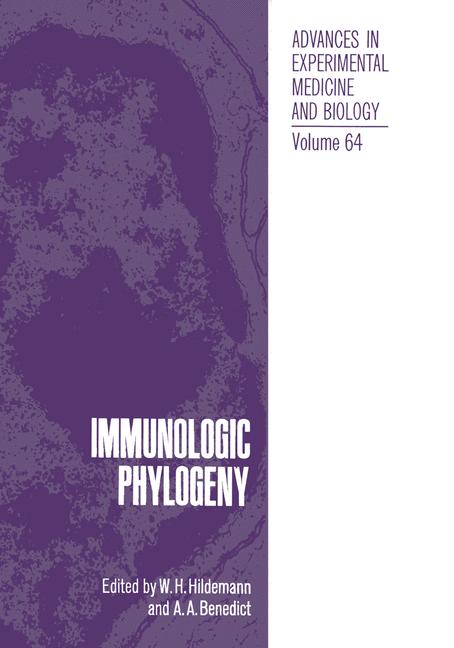
Immunologic Phylogeny
☆☆☆☆☆
(0 reviews)
Lowest price (incl. delivery)
58,99 USD
Typical price524,53 PLN
Lowest (90 days)35,99 PLN
Offers7
Last updatedpřed 1 týdnem
Price history (90 days)
Full history
2026-08-08
2026-08-15
| Aktualizováno | Cena |
|---|---|
| 2026-08-08 | 39,99 |
| 2026-08-14 | 35,99 |
| 2026-08-15 | 51,99 |
| Prodejce | Product price | Delivery | Celkem | Dostupnost | Updated | |
|---|---|---|---|---|---|---|
| SP SpringerNatureLink Shop INT | 39,99 USD | 19,00 USD | 58,99 USD | Dostupné | před 1 týdnem | View offer |
| SP SpringerNatureLink Shop INT | 7 149,00 JPY | 15,00 JPY | 7 164,00 JPY | Dostupné | před 6 dny | View offer |
| SP Springer Nature Author | 7 149,00 JPY | 15,00 JPY | 7 164,00 JPY | Dostupné | před 1 týdnem | View offer |
| SP SpringerNatureLink Shop INT | 49,99 USD | 19,00 USD | 68,99 USD | Dostupné | před 1 týdnem | View offer |
| SP SpringerNatureLink Shop INT | 54,99 USD | 25,00 USD | 79,99 USD | Dostupné | před 1 týdnem | View offer |
| SP SpringerNatureLink Shop INT | 54,99 USD | 19,00 USD | 73,99 USD | Dostupné | před 1 týdnem | View offer |
| SP SpringerNatureLink Shop INT | 59,00 EUR | 15,00 EUR | 74,00 EUR | Dostupné | před 1 týdnem | View offer |
Ceny a dostupnost se mohou změnit. Naposledy aktualizováno: 08.08.2026 23:08.
0,0
☆☆☆☆☆
0 reviews
5★
0%
4★
0%
3★
0%
2★
0%
1★
0%
Product reviews
No reviews yet — be the first!
There are two now classic reasons for the widespread and con tinuing interest in the phylogeny of immune reactivities and structure. First is the fundamental concern of biologists with the evolution of defense mechanisms. We are eager to discover origins, mechanisms, and adaptive specializations of immunocompetence because the very existence of individuals and entire species is involved in a most essential way. Second is the strong biomedical interest in adaptive immune mechanisms to increase understanding of health and disease in man. If man and placental mammals represent the quin tessence of immunoresponsiveness with complex interdependent path ways, the less elaborate but fully functional systems of immunity in "lower" animals proffer insights applicable to immediate con cerns in medicine. Recent approaches to organ transplantation, immunotherapy of cancer and repair of immunodeficiency diseases, to name just a few areas, have depended greatly on phylogenetic per spectives. In a larger sense, intelligent wildlife conservation, utilization of food resources, and adequate environmental protection all hinge on knowing how diverse species survive or otherwise suc cumb to insults, injuries, and disease. The phylogenetic immunologist also seeks detailed information on the structure of the immunoglobulins which relates directly to the evolutionary history of living animals. Perhaps genetic mech anisms responsible for the evolution of these proteins may be re vealed as spin-off information. The vast number of immunoglobulin specificities and effector structures, coupled with the remarkable phylogenetic conservation of certain polypeptide regions, makes these molecules especially useful to protein chemists as well as immunologists.
Similar products
 50 Years of Philosophy and Medicine
from $107.30
50 Years of Philosophy and Medicine
from $107.30
 Understanding Cybersecurity Law and Digital Privacy
from $122.63
Understanding Cybersecurity Law and Digital Privacy
from $122.63
 Decisions in International Trade and Logistics
from $122.63
Decisions in International Trade and Logistics
from $122.63
 Advances in Economic Measurement
from $122.63
Advances in Economic Measurement
from $122.63
 Nanomaterials
from $137.96
Nanomaterials
from $137.96
 Sustainable Scaffolds-based Strategies in Tissue Engineering and Regenerative Medicine
from $162.87
Sustainable Scaffolds-based Strategies in Tissue Engineering and Regenerative Medicine
from $162.87
 Narratives in Educational Research
from $162.87
Narratives in Educational Research
from $162.87
 Environmental Biology of the Young Chinese Sturgeon
from $210.78
Environmental Biology of the Young Chinese Sturgeon
from $210.78