
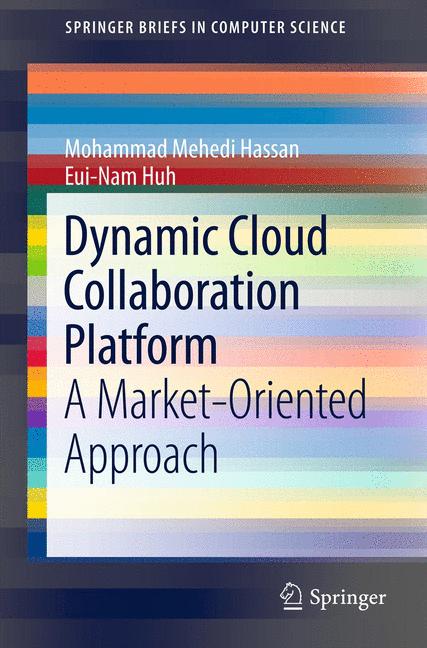
Dynamic Cloud Collaboration Platform
☆☆☆☆☆
(0 reviews)
Lowest price (incl. delivery)
7 168,00 JPY
Typical price314,07 PLN
Lowest (90 days)39,99 PLN
Offers2
Last updatedpřed 1 dnem
| Prodejce | Product price | Delivery | Celkem | Dostupnost | Updated | |
|---|---|---|---|---|---|---|
| SP Springer Nature Author | 7 149,00 JPY | 19,00 JPY | 7 168,00 JPY | Dostupné | před 1 dnem | View offer |
| SP SpringerNatureLink Shop INT | 59,00 EUR | 19,00 EUR | 78,00 EUR | Dostupné | před 1 dnem | View offer |
Ceny a dostupnost se mohou změnit. Naposledy aktualizováno: 08.08.2026 23:08.
0,0
☆☆☆☆☆
0 reviews
5★
0%
4★
0%
3★
0%
2★
0%
1★
0%
Product reviews
No reviews yet — be the first!
Present trends in cloud providers (CPs) capabilities have given rise to the interest in federating or collaborating clouds, thus allowing providers to revel on an increased scale and reach more than that is achievable individually. Current research efforts in this context mainly focus on building supply chain collaboration (SCC) models, in which CPs leverage cloud services from other CPs for seamless provisioning. Nevertheless, in the near future, we can expect that hundreds of CPs will compete to offer services and thousands of users will also compete to receive the services to run their complex heterogeneous applications on a cloud computing environment. In this open federation scenario, existing collaboration models (i.e. SCC) are not applicable since they are designed for static environments where a-priori agreements among the parties are needed to establish the federation. To move beyond these shortcomings, Dynamic Cloud Collaboration Platform establishes the basis for developing dynamic, advanced and efficient collaborative cloud service solutions that are scalable, high performance, and cost effective. We term the technology for inter-connection and inter-operation of CPs in open cloud federation as Dynamic Cloud Collaboration (DCC), in which various CPs (small, medium, and large) of complementary service requirements will collaborate dynamically to gain economies of scale and enlargements of their capabilities to meet quality of service (QoS) requirements of consumers. In this context, this book addresses four key issues - when to collaborate (triggering circumstances), whom to collaborate with (suitable partners), how to collaborate (architectural model), and how to demonstrate collaboration applicability (simulation study). It also provides solutions, which are effective in real environments.
Similar products
 Patient Safety Coaching
from $91.97
Patient Safety Coaching
from $91.97
 Ethnography and Diversity
from $69.30
Ethnography and Diversity
from $69.30
 Smart Villages
from $91.97
Smart Villages
from $91.97
 Nuclear Non-Proliferation in International Law - Volume VI
from $91.97
Nuclear Non-Proliferation in International Law - Volume VI
from $91.97
 The Price of Freedom
from $91.97
The Price of Freedom
from $91.97
 Eco-Social Policy in the OECD and the World Bank
from $91.97
Eco-Social Policy in the OECD and the World Bank
from $91.97
 Special Topics in Policing
from $122.58
Special Topics in Policing
from $122.58
 Music from the Heart
from $91.97
Music from the Heart
from $91.97