
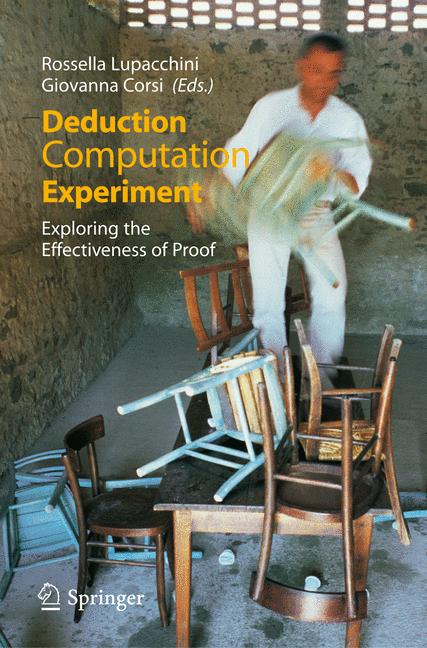
Deduction, Computation, Experiment
☆☆☆☆☆
(0 reviews)
Lowest price (incl. delivery)
14 299,00 JPY
Typical price1 121,54 PLN
Lowest (90 days)71,50 PLN
Offers6
Last updatedpřed 1 týdnem
Price history (90 days)
Full history
2026-08-08
2026-08-15
| Aktualizováno | Cena |
|---|---|
| 2026-08-08 | 84,99 |
| 2026-08-15 | 71,50 |
| Prodejce | Product price | Delivery | Celkem | Dostupnost | Updated | |
|---|---|---|---|---|---|---|
| SP SpringerNatureLink Shop INT | 14 299,00 JPY | free | 14 299,00 JPY | Dostupné | před 2 dny | View offer |
| SP Springer Nature Author | 14 299,00 JPY | 25,00 JPY | 14 324,00 JPY | Dostupné | před 1 týdnem | View offer |
| SP SpringerNatureLink Shop INT | 99,99 USD | free | 99,99 USD | Dostupné | před 2 dny | View offer |
| SP SpringerNatureLink Shop INT | 109,99 USD | 29,00 USD | 138,99 USD | Dostupné | před 2 dny | View offer |
| SP SpringerNatureLink Shop INT | 109,99 USD | free | 109,99 USD | Dostupné | před 2 dny | View offer |
| SP SpringerNatureLink Shop INT | 118,00 EUR | free | 118,00 EUR | Dostupné | před 2 dny | View offer |
Ceny a dostupnost se mohou změnit. Naposledy aktualizováno: 08.08.2026 23:21.
0,0
☆☆☆☆☆
0 reviews
5★
0%
4★
0%
3★
0%
2★
0%
1★
0%
Product reviews
No reviews yet — be the first!
This volume is located in a cross-disciplinary ?eld bringing together mat- matics, logic, natural science and philosophy. Re?ection on the e?ectiveness of proof brings out a number of questions that have always been latent in the informal understanding of the subject. What makes a symbolic constr- tion signi?cant? What makes an assumption reasonable? What makes a proof reliable? G¨ odel, Church and Turing, in di?erent ways, achieve a deep und- standing of the notion of e?ective calculability involved in the nature of proof. Turing’s work in particular provides a “precise and unquestionably adequate” de?nition of the general notion of a formal system in terms of a machine with a ?nite number of parts. On the other hand, Eugene Wigner refers to the - reasonable e?ectiveness of mathematics in the natural sciences as a miracle. Where should the boundary be traced between mathematical procedures and physical processes? What is the characteristic use of a proof as a com- tation, as opposed to its use as an experiment? What does natural science tell us about the e?ectiveness of proof? What is the role of mathematical proofs in the discovery and validation of empirical theories? The papers collected in this book are intended to search for some answers, to discuss conceptual and logical issues underlying such questions and, perhaps, to call attention to other relevant questions.
Similar products
 50 Years of Philosophy and Medicine
from $107.30
50 Years of Philosophy and Medicine
from $107.30
 Understanding Cybersecurity Law and Digital Privacy
from $122.63
Understanding Cybersecurity Law and Digital Privacy
from $122.63
 Decisions in International Trade and Logistics
from $122.63
Decisions in International Trade and Logistics
from $122.63
 Advances in Economic Measurement
from $122.63
Advances in Economic Measurement
from $122.63
 Nanomaterials
from $137.96
Nanomaterials
from $137.96
 Sustainable Scaffolds-based Strategies in Tissue Engineering and Regenerative Medicine
from $162.87
Sustainable Scaffolds-based Strategies in Tissue Engineering and Regenerative Medicine
from $162.87
 Narratives in Educational Research
from $162.87
Narratives in Educational Research
from $162.87
 Environmental Biology of the Young Chinese Sturgeon
from $210.78
Environmental Biology of the Young Chinese Sturgeon
from $210.78