
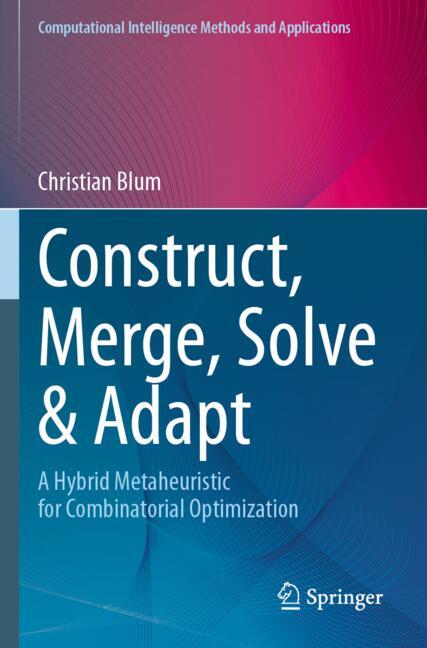
Construct, Merge, Solve & Adapt
☆☆☆☆☆
(0 reviews)
Lowest price (incl. delivery)
124,99 GBP
Typical price3 132,05 PLN
Lowest (90 days)128,39 PLN
Offers2
Last updatedpřed 4 dny
| Prodejce | Product price | Delivery | Celkem | Dostupnost | Updated | |
|---|---|---|---|---|---|---|
| SP SpringerNatureLink Shop INT | 99,99 GBP | 25,00 GBP | 124,99 GBP | Dostupné | před 4 dny | View offer |
| SP Springer Nature Author | 21 449,00 JPY | free | 21 449,00 JPY | Dostupné | před 4 dny | View offer |
Ceny a dostupnost se mohou změnit. Naposledy aktualizováno: 08.08.2026 23:28.
0,0
☆☆☆☆☆
0 reviews
5★
0%
4★
0%
3★
0%
2★
0%
1★
0%
Product reviews
No reviews yet — be the first!
This book describes a general hybrid metaheuristic for combinatorial optimization labeled Construct, Merge, Solve & Adapt (CMSA). The general idea of standard CMSA is the following one. At each iteration, a number of valid solutions to the tackled problem instance are generated in a probabilistic way. Hereby, each of these solutions is composed of a set of solution components. The components found in the generated solutions are then added to an initially empty sub-instance. Next, an exact solver is applied in order to compute the best solution of the sub-instance, which is then used to update the sub-instance provided as input for the next iteration. In this way, the power of exact solvers can be exploited for solving problem instances much too large for a standalone application of the solver. Important research lines on CMSA from recent years are covered in this book. After an introductory chapter about standard CMSA, subsequent chapters cover a self-adaptive CMSA variant as well as a variant equipped with a learning component for improving the quality of the generated solutions over time. Furthermore, on outlining the advantages of using set-covering-based integer linear programming models for sub-instance solving, the author shows how to apply CMSA to problems naturally modelled by non-binary integer linear programming models. The book concludes with a chapter on topics such as the development of a problem-agnostic CMSA and the relation between large neighborhood search and CMSA. Combinatorial optimization problems used in the book as test cases include the minimum dominating set problem, the variable-sized bin packing problem, and an electric vehicle routing problem. The book will be valuable and is intended for researchers, professionals and graduate students working in a wide range of fields, such as combinatorial optimization, algorithmics, metaheuristics, mathematical modeling, evolutionary computing, operations research, artificial intelligence, or statistics.
Similar products
 Patient Safety Coaching
from $91.97
Patient Safety Coaching
from $91.97
 Ethnography and Diversity
from $69.30
Ethnography and Diversity
from $69.30
 Smart Villages
from $91.97
Smart Villages
from $91.97
 Nuclear Non-Proliferation in International Law - Volume VI
from $91.97
Nuclear Non-Proliferation in International Law - Volume VI
from $91.97
 The Price of Freedom
from $91.97
The Price of Freedom
from $91.97
 Eco-Social Policy in the OECD and the World Bank
from $91.97
Eco-Social Policy in the OECD and the World Bank
from $91.97
 Special Topics in Policing
from $122.58
Special Topics in Policing
from $122.58
 Music from the Heart
from $91.97
Music from the Heart
from $91.97