
Chemical Complexity
☆☆☆☆☆
(0 reviews)
Lowest price (incl. delivery)
17 159,00 JPY
Typical price708,13 PLN
Lowest (90 days)59,99 PLN
Offers6
Last updatedpřed 1 týdnem
Price history (90 days)
Full history
2026-08-08
2026-08-15
| Aktualizováno | Cena |
|---|---|
| 2026-08-08 | 71,68 |
| 2026-08-15 | 59,99 |
| Prodejce | Product price | Delivery | Celkem | Dostupnost | Updated | |
|---|---|---|---|---|---|---|
| SP SpringerNatureLink Shop INT | 17 159,00 JPY | free | 17 159,00 JPY | Dostupné | před 1 týdnem | View offer |
| SP Springer Nature Author | 17 159,00 JPY | 15,00 JPY | 17 174,00 JPY | Dostupné | před 1 týdnem | View offer |
| SP SpringerNatureLink Shop INT | 119,99 USD | free | 119,99 USD | Dostupné | před 1 týdnem | View offer |
| SP SpringerNatureLink Shop INT | 129,99 USD | 29,00 USD | 158,99 USD | Dostupné | před 1 týdnem | View offer |
| SP SpringerNatureLink Shop INT | 129,99 USD | 25,00 USD | 154,99 USD | Dostupné | před 1 týdnem | View offer |
| SP SpringerNatureLink Shop INT | 142,00 EUR | 15,00 EUR | 157,00 EUR | Dostupné | před 1 týdnem | View offer |
Ceny a dostupnost se mohou změnit. Naposledy aktualizováno: 08.08.2026 22:18.
0,0
☆☆☆☆☆
0 reviews
5★
0%
4★
0%
3★
0%
2★
0%
1★
0%
Product reviews
No reviews yet — be the first!
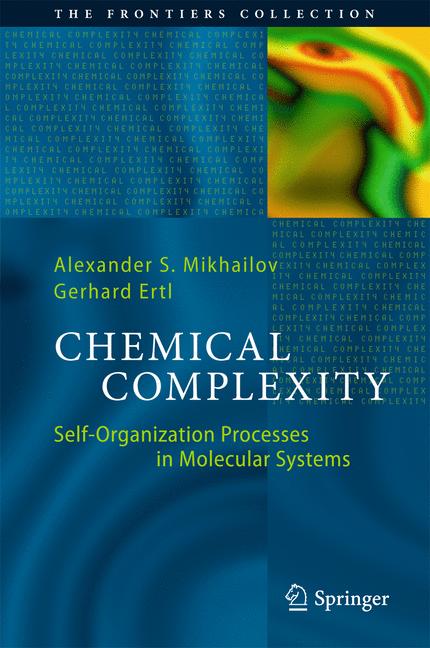
This book provides an outline of theoretical concepts and their experimental verification in studies of self-organization phenomena in chemical systems, as they emerged in the mid-20th century and have evolved since. Presenting essays on selected topics, it was prepared by authors who have made profound contributions to the field. Traditionally, physical chemistry has been concerned with interactions between atoms and molecules that produce a variety of equilibrium structures - or the 'dead' order - in a stationary state. But biological cells exhibit a different 'living' kind of order, prompting E. Schrödinger to pose his famous question “What is life?” in 1943. Through an unprecedented theoretical and experimental development, it was later revealed that biological self-organization phenomena are in complete agreement with the laws of physics, once they are applied to a special class of thermodynamically open systems and non-equilibrium states. This knowledge has in turn led tothe design and synthesis of simple inorganic systems capable of self-organization effects. These artificial 'living organisms' are able to operate on macroscopic to microscopic scales, even down to single-molecule machines. In the future, such research could provide a basis for a technological breakthrough, comparable in its impact with the invention of lasers and semiconductors. Its results can be used to control natural chemical processes, and to design artificial complex chemical processes with various functionalities. The book offers an extensive discussion of the history of research on complex chemical systems and its future prospects.
Similar products
 50 Years of Philosophy and Medicine
from $107.30
50 Years of Philosophy and Medicine
from $107.30
 Understanding Cybersecurity Law and Digital Privacy
from $122.63
Understanding Cybersecurity Law and Digital Privacy
from $122.63
 Decisions in International Trade and Logistics
from $122.63
Decisions in International Trade and Logistics
from $122.63
 Advances in Economic Measurement
from $122.63
Advances in Economic Measurement
from $122.63
 Nanomaterials
from $137.96
Nanomaterials
from $137.96
 Sustainable Scaffolds-based Strategies in Tissue Engineering and Regenerative Medicine
from $162.87
Sustainable Scaffolds-based Strategies in Tissue Engineering and Regenerative Medicine
from $162.87
 Narratives in Educational Research
from $162.87
Narratives in Educational Research
from $162.87
 Environmental Biology of the Young Chinese Sturgeon
from $210.78
Environmental Biology of the Young Chinese Sturgeon
from $210.78