
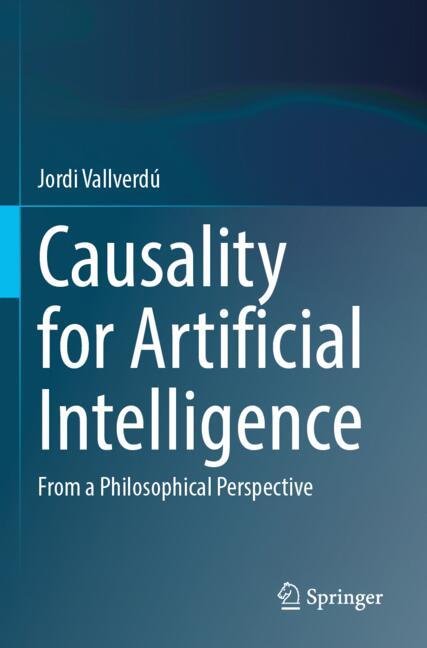
Causality for Artificial Intelligence
☆☆☆☆☆
(0 reviews)
Lowest price (incl. delivery)
68,70 EUR
Typical price61,71 PLN
Lowest (90 days)44,93 PLN
Offers3
Last updatedpřed 1 týdnem
Price history (90 days)
Full history
2026-08-08
2026-08-15
| Aktualizováno | Cena |
|---|---|
| 2026-08-08 | 44,93 |
| 2026-08-15 | 62,39 |
| Prodejce | Product price | Delivery | Celkem | Dostupnost | Updated | |
|---|---|---|---|---|---|---|
| SP Springer Nature Author | 49,70 EUR | 19,00 EUR | 68,70 EUR | Dostupné | před 1 týdnem | View offer |
| SP SpringerNatureLink Shop INT | 8 579,00 JPY | 29,00 JPY | 8 608,00 JPY | Dostupné | před 3 dny | View offer |
| SP SpringerNatureLink Shop INT | 65,99 EUR | 19,00 EUR | 84,99 EUR | Dostupné | před 3 dny | View offer |
Ceny a dostupnost se mohou změnit. Naposledy aktualizováno: 08.08.2026 21:09.
EAN
9789819731893
Springer Nature
0,0
☆☆☆☆☆
0 reviews
5★
0%
4★
0%
3★
0%
2★
0%
1★
0%
Product reviews
No reviews yet — be the first!
How can we teach machine learning to identify causal patterns in data? This book explores the very notion of “causality”, identifying from a naturalistic and evolutionary perspective how living systems deal with causal relationships. At the same time, using this knowledge to identify the best ways to apply such biological models in machine learning scenarios. One of the more fundamental challenges for AI experts is to design machines that can understand the world, identifying the basic rules that govern reality. Statistics are powerful and fundamental for this process, but they are only one of the necessary tools. Counterfactual thinking is the other part of the necessary process that will help machines to become intelligent. This book explains the paths that can lead to algorithmic causality. It is essential reading for those who are not afraid of thinking at the interface of various academic disciplines or fields (AI, machine learning, philosophy, neuroscience, anthropology, psychology, computer sciences), and who are interested in the analysis of causal thinking and the ways in which cognitive systems (natural or artificial) can act in order to understand their environment. Professor Vallverdú is currently working on biomimetic cognitive architectures and multicognitive systems. His research has explored two main areas: epistemology and cognition. Since his early Ph.D. research on epistemic controversies, he has analyzed several aspects of computational epistemology. His latest research has focused on the causal challenges of machine learning techniques, particularly deep learning. One of his most promising advances is statistics meets causal graph reasoning (via Directed Acyclic Graphs), which still has several conceptual paths that need to be explored and identified. Counterfactual reasoning is a fundamental part of these open debates, which are under the analysis of Prof. Vallverdú. His current research is supported as part of the following projects: GEHUCT and ICREA Acadèmia.
Similar products
 Gamma Knife Neurosurgery in the Management of Intracranial Disorders
from $210.78
Gamma Knife Neurosurgery in the Management of Intracranial Disorders
from $210.78
 SDGs in Construction Economics and Organization
from $210.78
SDGs in Construction Economics and Organization
from $210.78
 Emerging Therapies in Neurorehabilitation III
from $210.78
Emerging Therapies in Neurorehabilitation III
from $210.78
 Ground Improvement Techniques
from $220.36
Ground Improvement Techniques
from $220.36
 Anomaly Detection in Video Surveillance
from $220.36
Anomaly Detection in Video Surveillance
from $220.36
 Mechanism and Machine Science
from $287.42
Mechanism and Machine Science
from $287.42
 Protein-Protein Interactions as New Drug Targets
from $287.42
Protein-Protein Interactions as New Drug Targets
from $287.42
 Proceedings of the 7th International Conference of Transportation Research Group of India (CTRG 2023
from $287.42
Proceedings of the 7th International Conference of Transportation Research Group of India (CTRG 2023
from $287.42