
Scientific Workflows
☆☆☆☆☆
(0 reviews)
Lowest price (incl. delivery)
14 314,00 JPY
Typical price1 131,22 PLN
Lowest (90 days)71,50 PLN
Offers6
Last updatedمنذ أسبوع
Price history (90 days)
Full history
2026-08-08
2026-08-15
| تاريخ التحديث | السعر |
|---|---|
| 2026-08-08 | 84,99 |
| 2026-08-15 | 71,50 |
| البائع | Product price | Delivery | الإجمالي | التوفر | Updated | |
|---|---|---|---|---|---|---|
| SP SpringerNatureLink Shop INT | 14 299,00 JPY | 15,00 JPY | 14 314,00 JPY | متوفر | منذ 3 أيام | View offer |
| SP Springer Nature Author | 14 299,00 JPY | free | 14 299,00 JPY | متوفر | منذ أسبوع | View offer |
| SP SpringerNatureLink Shop INT | 99,99 USD | 29,00 USD | 128,99 USD | متوفر | منذ 3 أيام | View offer |
| SP SpringerNatureLink Shop INT | 109,99 USD | 19,00 USD | 128,99 USD | متوفر | منذ 3 أيام | View offer |
| SP SpringerNatureLink Shop INT | 109,99 USD | 29,00 USD | 138,99 USD | متوفر | منذ 3 أيام | View offer |
| SP SpringerNatureLink Shop INT | 118,00 EUR | 19,00 EUR | 137,00 EUR | متوفر | منذ 3 أيام | View offer |
قد تتغيّر الأسعار والتوفر. آخر تحديث: 08.08.2026 23:21.
0,0
☆☆☆☆☆
0 reviews
5★
0%
4★
0%
3★
0%
2★
0%
1★
0%
Product reviews
No reviews yet — be the first!
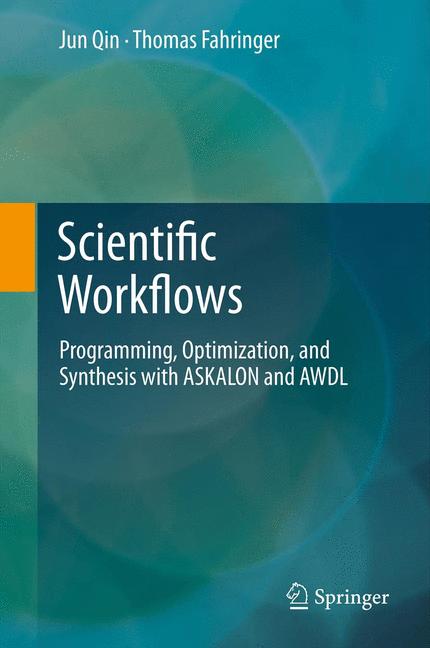
Creating scientific workflow applications is a very challenging task due to the complexity of the distributed computing environments involved, the complex control and data flow requirements of scientific applications, and the lack of high-level languages and tools support. Particularly, sophisticated expertise in distributed computing is commonly required to determine the software entities to perform computations of workflow tasks, the computers on which workflow tasks are to be executed, the actual execution order of workflow tasks, and the data transfer between them. Qin and Fahringer present a novel workflow language called Abstract Workflow Description Language (AWDL) and the corresponding standards-based, knowledge-enabled tool support, which simplifies the development of scientific workflow applications. AWDL is an XML-based language for describing scientific workflow applications at a high level of abstraction. It is designed in a way that allows users to concentrate on specifying such workflow applications without dealing with either the complexity of distributed computing environments or any specific implementation technology. This research monograph is organized into five parts: overview, programming, optimization, synthesis, and conclusion, and is complemented by an appendix and an extensive reference list. The topics covered in this book will be of interest to both computer science researchers (e.g. in distributed programming, grid computing, or large-scale scientific applications) and domain scientists who need to apply workflow technologies in their work, as well as engineers who want to develop distributed and high-throughput workflow applications, languages and tools.
Similar products
 50 Years of Philosophy and Medicine
from $107.30
50 Years of Philosophy and Medicine
from $107.30
 Understanding Cybersecurity Law and Digital Privacy
from $122.63
Understanding Cybersecurity Law and Digital Privacy
from $122.63
 Decisions in International Trade and Logistics
from $122.63
Decisions in International Trade and Logistics
from $122.63
 Advances in Economic Measurement
from $122.63
Advances in Economic Measurement
from $122.63
 Nanomaterials
from $137.96
Nanomaterials
from $137.96
 Sustainable Scaffolds-based Strategies in Tissue Engineering and Regenerative Medicine
from $162.87
Sustainable Scaffolds-based Strategies in Tissue Engineering and Regenerative Medicine
from $162.87
 Narratives in Educational Research
from $162.87
Narratives in Educational Research
from $162.87
 Environmental Biology of the Young Chinese Sturgeon
from $210.78
Environmental Biology of the Young Chinese Sturgeon
from $210.78