
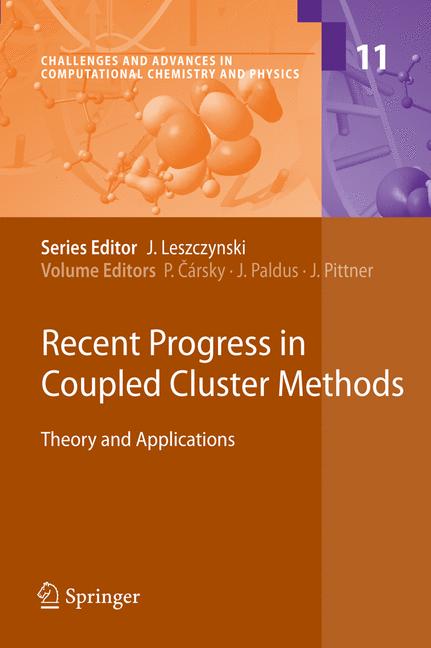
Recent Progress in Coupled Cluster Methods
☆☆☆☆☆
(0 reviews)
Lowest price (incl. delivery)
42 924,00 JPY
Typical price6 416,11 PLN
Lowest (90 days)320,99 PLN
Offers3
Last updatedمنذ أسبوع
Price history (90 days)
Full history
2026-08-08
2026-08-15
| تاريخ التحديث | السعر |
|---|---|
| 2026-08-08 | 320,99 |
| 2026-08-15 | 320,99 |
| البائع | Product price | Delivery | الإجمالي | التوفر | Updated | |
|---|---|---|---|---|---|---|
| SP SpringerNatureLink Shop INT | 42 899,00 JPY | 25,00 JPY | 42 924,00 JPY | متوفر | منذ 3 أيام | View offer |
| SP Springer Nature Author | 42 899,00 JPY | free | 42 899,00 JPY | متوفر | منذ أسبوع | View offer |
| SP SpringerNatureLink Shop INT | 354,00 EUR | 19,00 EUR | 373,00 EUR | متوفر | منذ 3 أيام | View offer |
قد تتغيّر الأسعار والتوفر. آخر تحديث: 08.08.2026 23:40.
EAN
9789400732759
Springer Nature
0,0
☆☆☆☆☆
0 reviews
5★
0%
4★
0%
3★
0%
2★
0%
1★
0%
Product reviews
No reviews yet — be the first!
I feel very honored that I have been asked to write a Foreword to this book. The subject of the book – “Coupled cluster theory” – has been around for about half a century. The basic theory and explicit equations for closed-shell ground states were formulated before 1970. At the beginning of the seventies the rst ab initio calcu- tion were carried out. At that time speed and memory of computers were very limited compared to today’s standards. Moreover, the size of one-electron bases employed was small, so that it was only possible to achieve an orientation in methodical aspects rather than to generate new signi cant results. Extensive use of the coupled-cluster method started at the beginning of the eighties. With the help of more powerful computers the results of coupled-cluster approaches started to yield more and more interesting results of relevance to the interpretation of experimental data. New ideas in methodology kept appearing and computer codes became more and more ef cient. This exciting situation continues to this very day. Remarkably enough, even the - quired equations can now be generated by a computer with the help of symbolic languages. The size of this monograph and the rich variety of articles it contains attests to the usefulness and viability of the couple-cluster formalism for the h- dling of many-electron correlation effects. This represents a vivid testimony of a tremendous work that has been accomplished in coupled-cluster methodology and its exploitation.
Similar products
 50 Years of Philosophy and Medicine
from $107.30
50 Years of Philosophy and Medicine
from $107.30
 Understanding Cybersecurity Law and Digital Privacy
from $122.63
Understanding Cybersecurity Law and Digital Privacy
from $122.63
 Decisions in International Trade and Logistics
from $122.63
Decisions in International Trade and Logistics
from $122.63
 Advances in Economic Measurement
from $122.63
Advances in Economic Measurement
from $122.63
 Nanomaterials
from $137.96
Nanomaterials
from $137.96
 Sustainable Scaffolds-based Strategies in Tissue Engineering and Regenerative Medicine
from $162.87
Sustainable Scaffolds-based Strategies in Tissue Engineering and Regenerative Medicine
from $162.87
 Narratives in Educational Research
from $162.87
Narratives in Educational Research
from $162.87
 Environmental Biology of the Young Chinese Sturgeon
from $210.78
Environmental Biology of the Young Chinese Sturgeon
from $210.78