
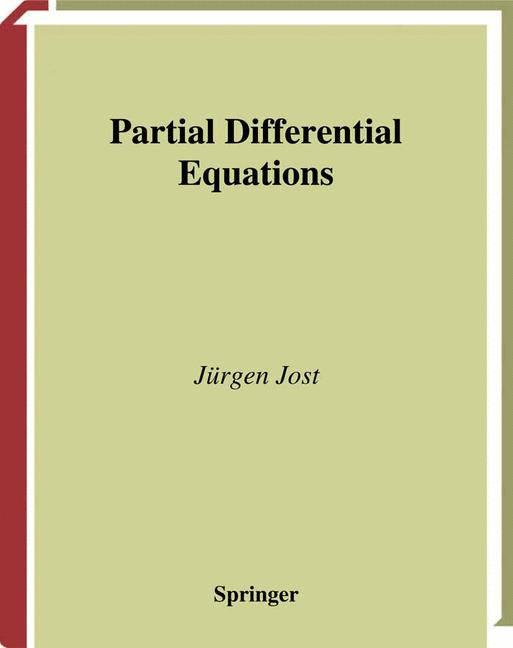
Partial Differential Equations
☆☆☆☆☆
(0 reviews)
Lowest price (incl. delivery)
9 151,00 JPY
Typical price6 884,50 PLN
Lowest (90 days)85,00 PLN
Offers2
Last updatedمنذ 6 أيام
Price history (90 days)
Full history
2026-08-08
2026-08-15
| تاريخ التحديث | السعر |
|---|---|
| 2026-08-08 | 85,00 |
| 2026-08-15 | 9 151,00 |
| البائع | Product price | Delivery | الإجمالي | التوفر | Updated | |
|---|---|---|---|---|---|---|
| SP SpringerNatureLink Shop INT | 9 151,00 JPY | free | 9 151,00 JPY | متوفر | منذ 5 ساعات | View offer |
| SP Springer Nature Author | 9 151,00 JPY | 15,00 JPY | 9 166,00 JPY | متوفر | منذ 6 أيام | View offer |
قد تتغيّر الأسعار والتوفر. آخر تحديث: 08.08.2026 23:18.
EAN
9780387215952
Springer Nature
0,0
☆☆☆☆☆
0 reviews
5★
0%
4★
0%
3★
0%
2★
0%
1★
0%
Product reviews
No reviews yet — be the first!
This textbook is intended for students who wish to obtain an introduction to the theory of partial di?erential equations (PDEs, for short), in particular, those of elliptic type. Thus, it does not o?er a comprehensive overview of the whole ?eld of PDEs, but tries to lead the reader to the most important methods and central results in the case of elliptic PDEs. The guiding qu- tion is how one can ?nd a solution of such a PDE. Such a solution will, of course, depend on given constraints and, in turn, if the constraints are of the appropriate type, be uniquely determined by them. We shall pursue a number of strategies for ?nding a solution of a PDE; they can be informally characterized as follows: (0) Write down an explicit formula for the solution in terms of the given data (constraints). This may seem like the best and most natural approach, but this is possible only in rather particular and special cases. Also, such a formula may be rather complicated, so that it is not very helpful for detecting qualitative properties of a solution. Therefore, mathematical analysis has developed other, more powerful, approaches. (1) Solve a sequence of auxiliary problems that approximate the given one, and show that their solutions converge to a solution of that original pr- lem. Di?erential equations are posed in spaces of functions, and those spaces are of in?nite dimension.
Similar products
 50 Years of Philosophy and Medicine
from $107.30
50 Years of Philosophy and Medicine
from $107.30
 Understanding Cybersecurity Law and Digital Privacy
from $122.63
Understanding Cybersecurity Law and Digital Privacy
from $122.63
 Decisions in International Trade and Logistics
from $122.63
Decisions in International Trade and Logistics
from $122.63
 Advances in Economic Measurement
from $122.63
Advances in Economic Measurement
from $122.63
 Nanomaterials
from $137.96
Nanomaterials
from $137.96
 Sustainable Scaffolds-based Strategies in Tissue Engineering and Regenerative Medicine
from $162.87
Sustainable Scaffolds-based Strategies in Tissue Engineering and Regenerative Medicine
from $162.87
 Narratives in Educational Research
from $162.87
Narratives in Educational Research
from $162.87
 Environmental Biology of the Young Chinese Sturgeon
from $210.78
Environmental Biology of the Young Chinese Sturgeon
from $210.78