
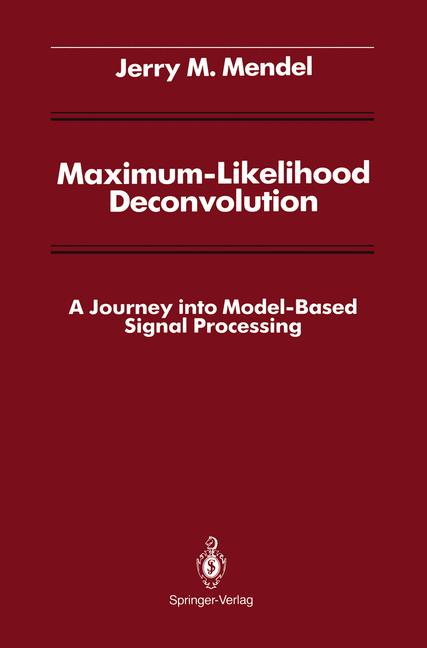
Maximum-Likelihood Deconvolution
☆☆☆☆☆
(0 reviews)
Lowest price (incl. delivery)
7 174,00 JPY
Typical price362,20 PLN
Lowest (90 days)49,99 PLN
Offers2
Last updatedمنذ 7 ساعات
| البائع | Product price | Delivery | الإجمالي | التوفر | Updated | |
|---|---|---|---|---|---|---|
| SP Springer Nature Author | 7 149,00 JPY | 25,00 JPY | 7 174,00 JPY | متوفر | منذ 7 ساعات | View offer |
| SP SpringerNatureLink Shop INT | 59,00 EUR | 19,00 EUR | 78,00 EUR | متوفر | منذ 19 ساعة | View offer |
قد تتغيّر الأسعار والتوفر. آخر تحديث: 08.08.2026 23:12.
0,0
☆☆☆☆☆
0 reviews
5★
0%
4★
0%
3★
0%
2★
0%
1★
0%
Product reviews
No reviews yet — be the first!
Convolution is the most important operation that describes the behavior of a linear time-invariant dynamical system. Deconvolution is the unraveling of convolution. It is the inverse problem of generating the system's input from knowledge about the system's output and dynamics. Deconvolution requires a careful balancing of bandwidth and signal-to-noise ratio effects. Maximum-likelihood deconvolution (MLD) is a design procedure that handles both effects. It draws upon ideas from Maximum Likelihood, when unknown parameters are random. It leads to linear and nonlinear signal processors that provide high-resolution estimates of a system's input. All aspects of MLD are described, from first principles in this book. The purpose of this volume is to explain MLD as simply as possible. To do this, the entire theory of MLD is presented in terms of a convolutional signal generating model and some relatively simple ideas from optimization theory. Earlier approaches to MLD, which are couched in the language of state-variable models and estimation theory, are unnecessary to understand the essence of MLD. MLD is a model-based signal processing procedure, because it is based on a signal model, namely the convolutional model. The book focuses on three aspects of MLD: (1) specification of a probability model for the system's measured output; (2) determination of an appropriate likelihood function; and (3) maximization of that likelihood function. Many practical algorithms are obtained. Computational aspects of MLD are described in great detail. Extensive simulations are provided, including real data applications.
Similar products
 Patient Safety Coaching
from $91.97
Patient Safety Coaching
from $91.97
 Ethnography and Diversity
from $69.30
Ethnography and Diversity
from $69.30
 Smart Villages
from $91.97
Smart Villages
from $91.97
 Nuclear Non-Proliferation in International Law - Volume VI
from $91.97
Nuclear Non-Proliferation in International Law - Volume VI
from $91.97
 The Price of Freedom
from $91.97
The Price of Freedom
from $91.97
 Eco-Social Policy in the OECD and the World Bank
from $91.97
Eco-Social Policy in the OECD and the World Bank
from $91.97
 Special Topics in Policing
from $122.58
Special Topics in Policing
from $122.58
 Music from the Heart
from $91.97
Music from the Heart
from $91.97