
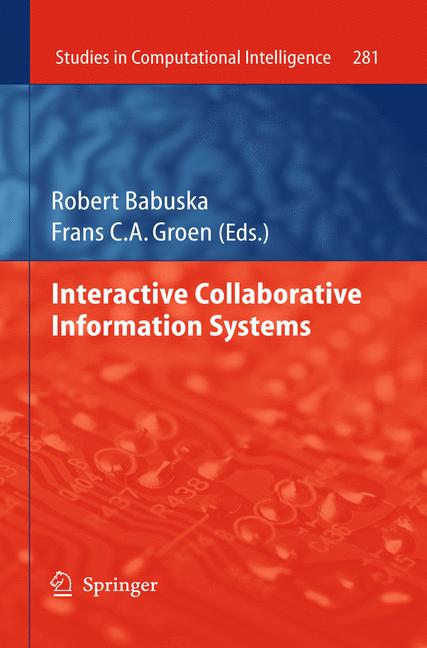
Interactive Collaborative Information Systems
☆☆☆☆☆
(0 reviews)
Lowest price (incl. delivery)
28 614,00 JPY
Typical price4 582,61 PLN
Lowest (90 days)179,99 PLN
Offers1
Last updatedمنذ يوم
| البائع | Product price | Delivery | الإجمالي | التوفر | Updated | |
|---|---|---|---|---|---|---|
| SP Springer Nature Author | 28 599,00 JPY | 15,00 JPY | 28 614,00 JPY | متوفر | منذ يوم | View offer |
قد تتغيّر الأسعار والتوفر. آخر تحديث: 08.08.2026 23:38.
0,0
☆☆☆☆☆
0 reviews
5★
0%
4★
0%
3★
0%
2★
0%
1★
0%
Product reviews
No reviews yet — be the first!
The increasing complexity of our world demands new perspectives on the role of technology in decision making. Human decision making has its li- tations in terms of information-processing capacity. We need new technology to cope with the increasingly complex and information-rich nature of our modern society. This is particularly true for critical environments such as crisis management and tra?c management, where humans need to engage in close collaborations with arti?cial systems to observe and understand the situation and respond in a sensible way. We believe that close collaborations between humans and arti?cial systems will become essential and that the importance of research into Interactive Collaborative Information Systems (ICIS) is self-evident. Developments in information and communication technology have ra- cally changed our working environments. The vast amount of information available nowadays and the wirelessly networked nature of our modern so- ety open up new opportunities to handle di?cult decision-making situations such as computer-supported situation assessment and distributed decision making. To make good use of these new possibilities, we need to update our traditional views on the role and capabilities of information systems. The aim of the Interactive Collaborative Information Systems project is to develop techniques that support humans in complex information en- ronments and that facilitate distributed decision-making capabilities. ICIS emphasizes the importance of building actor-agent communities: close c- laborations between human and arti?cial actors that highlight their comp- mentary capabilities, and in which task distribution is ?exible and adaptive.
Similar products
 Gamma Knife Neurosurgery in the Management of Intracranial Disorders
from $210.78
Gamma Knife Neurosurgery in the Management of Intracranial Disorders
from $210.78
 SDGs in Construction Economics and Organization
from $210.78
SDGs in Construction Economics and Organization
from $210.78
 Emerging Therapies in Neurorehabilitation III
from $210.78
Emerging Therapies in Neurorehabilitation III
from $210.78
 Ground Improvement Techniques
from $220.36
Ground Improvement Techniques
from $220.36
 Anomaly Detection in Video Surveillance
from $220.36
Anomaly Detection in Video Surveillance
from $220.36
 Mechanism and Machine Science
from $287.42
Mechanism and Machine Science
from $287.42
 Protein-Protein Interactions as New Drug Targets
from $287.42
Protein-Protein Interactions as New Drug Targets
from $287.42
 Proceedings of the 7th International Conference of Transportation Research Group of India (CTRG 2023
from $287.42
Proceedings of the 7th International Conference of Transportation Research Group of India (CTRG 2023
from $287.42