
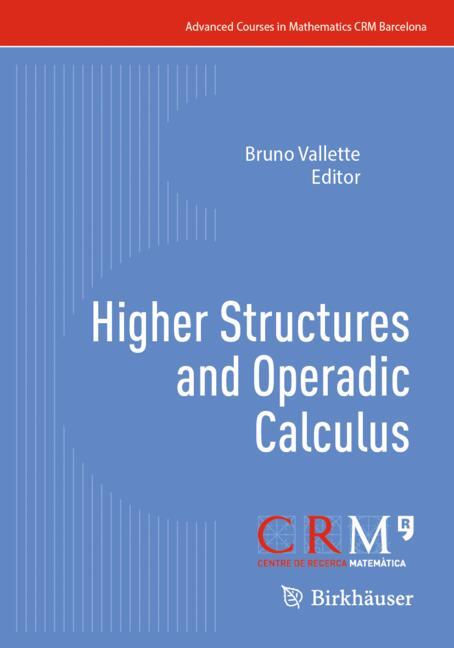
Higher Structures and Operadic Calculus
☆☆☆☆☆
(0 reviews)
Lowest price (incl. delivery)
63,49 USD
Typical price39,20 PLN
Lowest (90 days)30,79 PLN
Offers7
Last updatedمنذ أسبوع
Price history (90 days)
Full history
2026-08-08
2026-08-15
| تاريخ التحديث | السعر |
|---|---|
| 2026-08-08 | 37,44 |
| 2026-08-14 | 30,79 |
| 2026-08-15 | 37,44 |
| البائع | Product price | Delivery | الإجمالي | التوفر | Updated | |
|---|---|---|---|---|---|---|
| SP SpringerNatureLink Shop INT | 38,49 USD | 25,00 USD | 63,49 USD | متوفر | منذ 5 أيام | View offer |
| SP SpringerNatureLink Shop INT | 45,49 USD | free | 45,49 USD | متوفر | منذ 5 أيام | View offer |
| SP SpringerNatureLink Shop INT | 45,49 USD | free | 45,49 USD | متوفر | منذ 5 أيام | View offer |
| SP SpringerNatureLink Shop INT | 48,99 USD | free | 48,99 USD | متوفر | منذ 5 أيام | View offer |
| SP SpringerNatureLink Shop INT | 48,99 USD | free | 48,99 USD | متوفر | منذ 5 أيام | View offer |
| SP Springer Nature Author | 48,99 USD | 25,00 USD | 73,99 USD | متوفر | منذ أسبوع | View offer |
| SP SpringerNatureLink Shop INT | 53,90 EUR | free | 53,90 EUR | متوفر | منذ 5 أيام | View offer |
قد تتغيّر الأسعار والتوفر. آخر تحديث: 08.08.2026 12:17.
0,0
☆☆☆☆☆
0 reviews
5★
0%
4★
0%
3★
0%
2★
0%
1★
0%
Product reviews
No reviews yet — be the first!
This book presents the notes originating from five series of lectures given at the CRM Barcelona in 21-25 June, 2021, during the “Higher homotopical structures” programme. Since their introduction 60 years ago, the notions of infinity algebras (Stasheff, Sugawara), higher categories (Boardman-Vogt), operads (May), and model categories (Quillen) have given rise to powerful new tools which made possible the resolution of open problems and prompted revolutions in many domains like algebraic topology (rational homotopy theory, faithful algebraic invariants of the homotopy type of spaces), deformation theory (formality theorems, formal moduli problems), and mathematical physics (quantization of Poisson manifolds, quantum field theories), to name but a few. This theory of higher structures using operadic calculus is currently under rapid development. The aim of this book is to provide the community with an accessible state-of-the-art, while at the same time giving interested researchers and advanced students a brief overview on the subject.
Similar products
 50 Years of Philosophy and Medicine
from $107.30
50 Years of Philosophy and Medicine
from $107.30
 Understanding Cybersecurity Law and Digital Privacy
from $122.63
Understanding Cybersecurity Law and Digital Privacy
from $122.63
 Decisions in International Trade and Logistics
from $122.63
Decisions in International Trade and Logistics
from $122.63
 Advances in Economic Measurement
from $122.63
Advances in Economic Measurement
from $122.63
 Nanomaterials
from $137.96
Nanomaterials
from $137.96
 Sustainable Scaffolds-based Strategies in Tissue Engineering and Regenerative Medicine
from $162.87
Sustainable Scaffolds-based Strategies in Tissue Engineering and Regenerative Medicine
from $162.87
 Narratives in Educational Research
from $162.87
Narratives in Educational Research
from $162.87
 Environmental Biology of the Young Chinese Sturgeon
from $210.78
Environmental Biology of the Young Chinese Sturgeon
from $210.78