
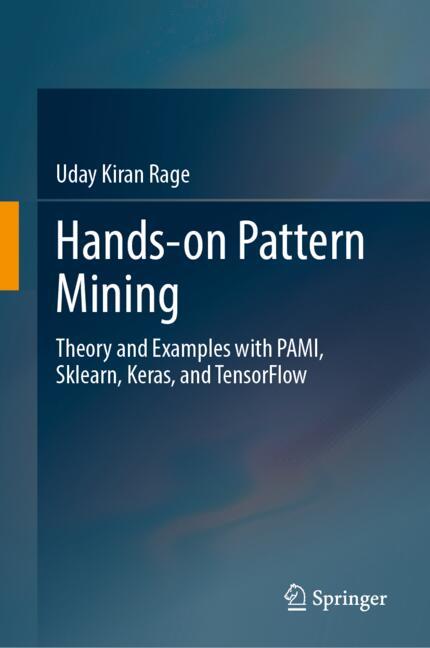
Hands-on Pattern Mining
☆☆☆☆☆
(0 reviews)
Lowest price (incl. delivery)
93,19 EUR
Typical price66,86 PLN
Lowest (90 days)62,39 PLN
Offers3
Last updatedمنذ 5 أيام
| البائع | Product price | Delivery | الإجمالي | التوفر | Updated | |
|---|---|---|---|---|---|---|
| VI VitalSource | 64,19 EUR | 29,00 EUR | 93,19 EUR | متوفر | منذ 5 أيام | View offer |
| SP SpringerNatureLink Shop INT | 71,00 EUR | free | 71,00 EUR | متوفر | منذ 5 أيام | View offer |
| SP Springer Nature Author | 71,00 EUR | free | 71,00 EUR | متوفر | منذ 4 أيام | View offer |
قد تتغيّر الأسعار والتوفر. آخر تحديث: 08.08.2026 12:03.
EAN
9789819667901
Springer Nature
0,0
☆☆☆☆☆
0 reviews
5★
0%
4★
0%
3★
0%
2★
0%
1★
0%
Product reviews
No reviews yet — be the first!
This book introduces pattern mining by presenting various pattern mining techniques and giving hands-on experience with each technique. Pattern mining is a popular data mining technique with many real-world applications, and involves discovering all user interest-based patterns that may exist in a database. Several models and numerous algorithms were described in the literature to find these patterns in binary databases, quantitative databases, uncertain databases, and streams. Since the lack of a Python toolkit containing these algorithms has limited the wide adaptability of pattern-mining techniques, the author developed Pattern Mining (PAMI) Python library, which currently contains 80+ algorithms to discover useful patterns in transactional databases, temporal databases, quantitative databases, and graphs. The book consists of three main parts: · Introduction: The first chapter introduces big data, types of learning techniques, and the importance of pattern mining. The second chapter introduces the PAMI library, its organizational structure, installation, and usage. · Pattern mining algorithms and examples: The following chapters present the state-of-the-art techniques for discovering user interest-based patterns in (1) transactional databases, (2) temporal databases, (3) quantitative databases, (4) uncertain databases, (5) sequential databases, and (6) graphs. · Applications: The book concludes with several applications, where the predicted knowledge using TensorFlow and PyTorch was transformed into a database to discover future trends or patterns.