
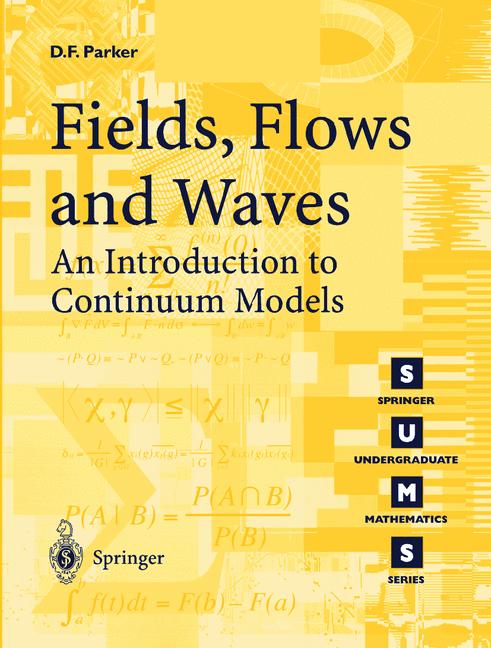
Fields, Flows and Waves
☆☆☆☆☆
(0 reviews)
Lowest price (incl. delivery)
58,05 EUR
Typical price243,76 PLN
Lowest (90 days)18,01 PLN
Offers3
Last updatedمنذ أسبوع
Price history (90 days)
Full history
2026-08-07
2026-08-14
| تاريخ التحديث | السعر |
|---|---|
| 2026-08-07 | 18,01 |
| 2026-08-08 | 29,05 |
| 2026-08-14 | 29,05 |
| البائع | Product price | Delivery | الإجمالي | التوفر | Updated | |
|---|---|---|---|---|---|---|
| SP SpringerNatureLink Shop INT | 29,05 EUR | 29,00 EUR | 58,05 EUR | متوفر | منذ يوم | View offer |
| SP Springer Nature Author | 5 004,00 JPY | 29,00 JPY | 5 033,00 JPY | متوفر | منذ أسبوع | View offer |
| VI VitalSource | 199,24 ZAR | free | 199,24 ZAR | متوفر | منذ أسبوع | View offer |
قد تتغيّر الأسعار والتوفر. آخر تحديث: 08.08.2026 05:21.
EAN
9781852337087
Springer Nature
0,0
☆☆☆☆☆
0 reviews
5★
0%
4★
0%
3★
0%
2★
0%
1★
0%
Product reviews
No reviews yet — be the first!
Many phenomena in the physical and biological sciences involve the collective behaviour of (very large) numbers of individual objects. For example, the be haviour of gases ultimately concerns the interacting motions of uncountably many atoms and molecules, but to understand flow in nozzles, around aircraft and in meteorology it is best to treat velocity and density as continuous func tions of position and time and then to analyse the associated flows. Although modern electronics involves ever smaller components, even the semiconduc tor devices used widely in electronic communications and in digital processing involve collective phenomena, such as electric currents and fields, which are continuously varying functions of position and time. Diffusion and reaction between various chemical constituents, the growth and spread of biological or ganisms and the flow of traffic on major highways are all phenomena which may be described and analysed in terms of fields and flows, while sound, light and various other electromagnetic phenomena involve both fields and waves. Treating these using a continuum model, which does not attempt to trace the motion and evolution of individual objects, often gives good predictions. The mathematical concepts and techniques which underlie such treatments are the subject of this book. This book is designed as a first introduction to the use of mathematical techniques, within continuum theories.
Similar products
 50 Years of Philosophy and Medicine
from $107.30
50 Years of Philosophy and Medicine
from $107.30
 Understanding Cybersecurity Law and Digital Privacy
from $122.63
Understanding Cybersecurity Law and Digital Privacy
from $122.63
 Decisions in International Trade and Logistics
from $122.63
Decisions in International Trade and Logistics
from $122.63
 Advances in Economic Measurement
from $122.63
Advances in Economic Measurement
from $122.63
 Nanomaterials
from $137.96
Nanomaterials
from $137.96
 Sustainable Scaffolds-based Strategies in Tissue Engineering and Regenerative Medicine
from $162.87
Sustainable Scaffolds-based Strategies in Tissue Engineering and Regenerative Medicine
from $162.87
 Narratives in Educational Research
from $162.87
Narratives in Educational Research
from $162.87
 Environmental Biology of the Young Chinese Sturgeon
from $210.78
Environmental Biology of the Young Chinese Sturgeon
from $210.78