
Effective Evolution Equations from Quantum Dynamics
☆☆☆☆☆
(0 reviews)
Lowest price (incl. delivery)
7 178,00 JPY
Typical price524,53 PLN
Lowest (90 days)35,99 PLN
Offers6
Last updatedمنذ أسبوع
Price history (90 days)
Full history
2026-08-08
2026-08-15
| تاريخ التحديث | السعر |
|---|---|
| 2026-08-08 | 39,99 |
| 2026-08-14 | 35,99 |
| 2026-08-15 | 51,99 |
| البائع | Product price | Delivery | الإجمالي | التوفر | Updated | |
|---|---|---|---|---|---|---|
| SP SpringerNatureLink Shop INT | 7 149,00 JPY | 29,00 JPY | 7 178,00 JPY | متوفر | منذ 19 ساعة | View offer |
| SP Springer Nature Author | 7 149,00 JPY | 25,00 JPY | 7 174,00 JPY | متوفر | منذ أسبوع | View offer |
| SP SpringerNatureLink Shop INT | 49,99 USD | 15,00 USD | 64,99 USD | متوفر | منذ يوم | View offer |
| SP SpringerNatureLink Shop INT | 54,99 USD | 15,00 USD | 69,99 USD | متوفر | منذ يوم | View offer |
| SP SpringerNatureLink Shop INT | 54,99 USD | 29,00 USD | 83,99 USD | متوفر | منذ يوم | View offer |
| SP SpringerNatureLink Shop INT | 59,00 EUR | free | 59,00 EUR | متوفر | منذ يوم | View offer |
قد تتغيّر الأسعار والتوفر. آخر تحديث: 08.08.2026 23:08.
0,0
☆☆☆☆☆
0 reviews
5★
0%
4★
0%
3★
0%
2★
0%
1★
0%
Product reviews
No reviews yet — be the first!
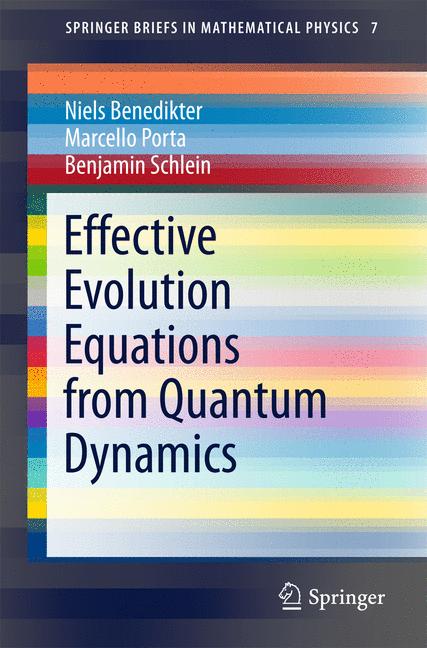
These notes investigate the time evolution of quantum systems, and in particular the rigorous derivation of effective equations approximating the many-body Schrödinger dynamics in certain physically interesting regimes. The focus is primarily on the derivation of time-dependent effective theories (non-equilibrium question) approximating many-body quantum dynamics. The book is divided into seven sections, the first of which briefly reviews the main properties of many-body quantum systems and their time evolution. Section 2 introduces the mean-field regime for bosonic systems and explains how the many-body dynamics can be approximated in this limit using the Hartree equation. Section 3 presents a method, based on the use of coherent states, for rigorously proving the convergence towards the Hartree dynamics, while the fluctuations around the Hartree equation are considered in Section 4. Section 5 focuses on a discussion of a more subtle regime, in which the many-body evolution can be approximated by means of the nonlinear Gross-Pitaevskii equation. Section 6 addresses fermionic systems (characterized by antisymmetric wave functions); here, the fermionic mean-field regime is naturally linked with a semiclassical regime, and it is proven that the evolution of approximate Slater determinants can be approximated using the nonlinear Hartree-Fock equation. In closing, Section 7 reexamines the same fermionic mean-field regime, but with a focus on mixed quasi-free initial data approximating thermal states at positive temperature.
Similar products
 50 Years of Philosophy and Medicine
from $107.30
50 Years of Philosophy and Medicine
from $107.30
 Understanding Cybersecurity Law and Digital Privacy
from $122.63
Understanding Cybersecurity Law and Digital Privacy
from $122.63
 Decisions in International Trade and Logistics
from $122.63
Decisions in International Trade and Logistics
from $122.63
 Advances in Economic Measurement
from $122.63
Advances in Economic Measurement
from $122.63
 Nanomaterials
from $137.96
Nanomaterials
from $137.96
 Sustainable Scaffolds-based Strategies in Tissue Engineering and Regenerative Medicine
from $162.87
Sustainable Scaffolds-based Strategies in Tissue Engineering and Regenerative Medicine
from $162.87
 Narratives in Educational Research
from $162.87
Narratives in Educational Research
from $162.87
 Environmental Biology of the Young Chinese Sturgeon
from $210.78
Environmental Biology of the Young Chinese Sturgeon
from $210.78